Making climate readiness visible.
State-level climate readiness, made public. Track, compare, and hold accountable.
The Climate Action Index (CAI) evaluates climate governance, risk exposure, fiscal readiness, and transparency across Nigeria's 36 states and the Federal Capital Territory, to drive accountability and catalyse stronger climate action.
What is the Climate Action Index?
- A public dashboard tracking climate readiness across Nigeria's 36 states and the FCT.
- Translates public documents into transparent, comparable scores, not opinions.
- Built on three pillars: policy alignment, spending efficiency, outcome transparency.
- Evidence rule: absence of public evidence is scored 0 and flagged as a data gap.
- Made for governments, civil society, researchers, journalists, and young advocates.
The 40 / 30 / 30 framework
- Policy alignment (40%)
- Are plans, mandates, and institutions in place?
- Spending efficiency (30%)
- Are budgets allocated and traceable to climate work?
- Outcome transparency (30%)
- Is delivery reported, measurable, and publicly visible?
Why climate readiness visibility matters
You cannot strengthen what you cannot see. Making climate readiness visible turns climate action into something people can track, debate, and improve.
Climate risk is local
Floods, heat, drought, and displacement land first on states, schools, and communities, visibility has to start there.
Subnational governments matter
Much of climate readiness happens at the state level, through budgets, plans, agencies, and on-the-ground delivery.
Public evidence over claims
CAI's evidence rule: absence of public evidence is scored as 0 and flagged as a data gap, so readiness can be discussed, not assumed.
Gaps become opportunities
Making evidence gaps visible helps governments, donors, and civic actors target support where it is most needed.
Baseline snapshot
A national picture of subnational climate readiness. Even with measurable improvement in FY2025, most states remain below 30% readiness, gains at the top mask large disparities below.
37
36 states + Federal Capital Territory
23.9%
National average across 37 governments
8.6%
Reference year for comparison
10
Across policy, spending, outcomes & transparency
States improved: 30
States improved
Stronger readiness signals year-over-year
States declined: 5
States declined
Weaker signals vs. prior baseline
States unchanged: 2
States unchanged
No material change between baselines
Source: Climate Action Index FY2024–FY2025 baseline · www.climateactionindex.org
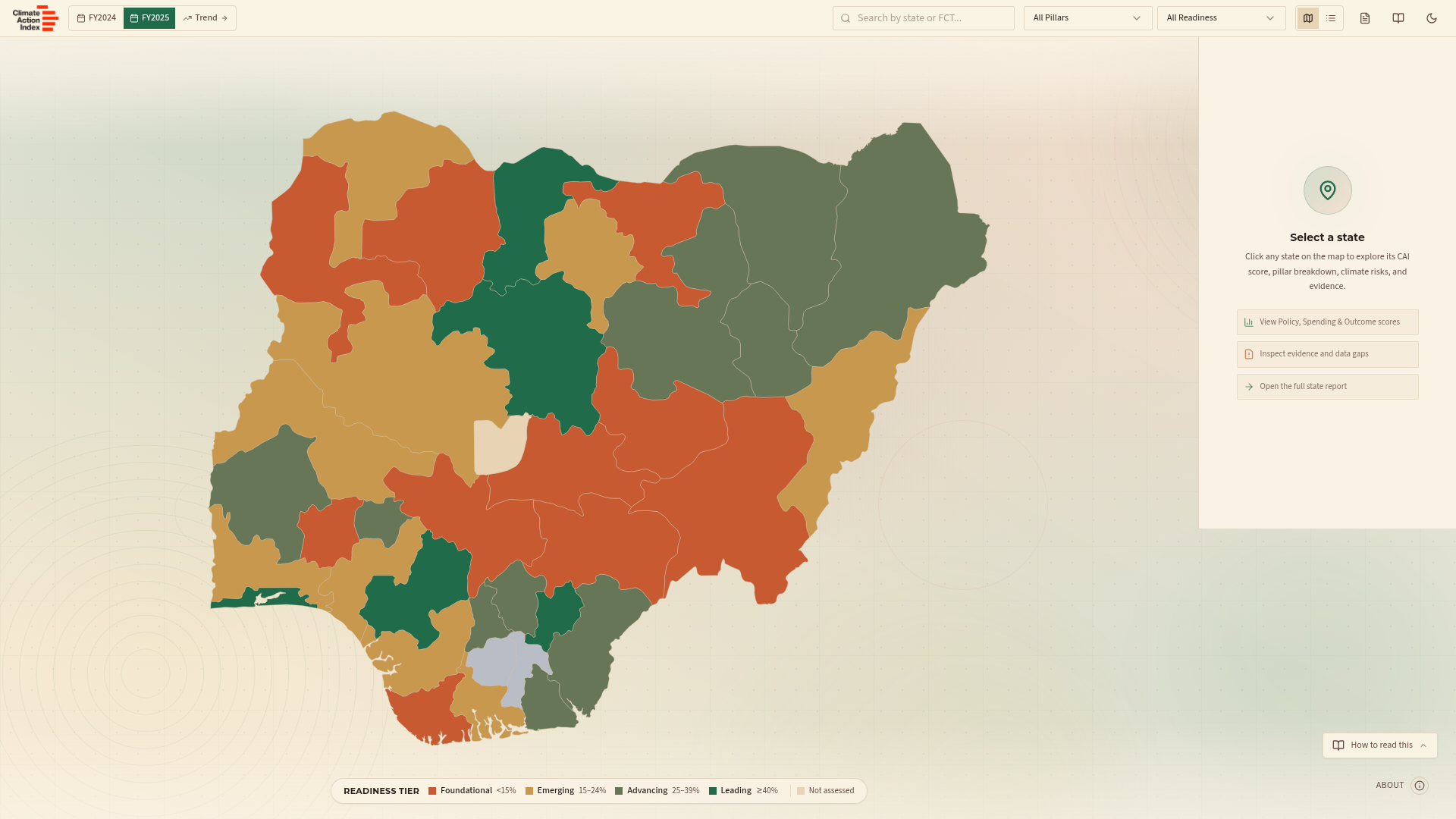
Explore readiness across all 36 states + FCT.
The CAI dashboard ranks every Nigerian state and the Federal Capital Territory by readiness tier, from Foundational to Leading, built from publicly available evidence across policy, spending, and outcomes.
- Foundational<15% readiness
- Emerging15–24% readiness
- Advancing25–39% readiness
- Leading≥40% readiness
Read the research
CAI's methodology explains how publicly available documents, climate plans, budgets, agency reports , become comparable readiness scores. It documents the three-pillar framework, the 10 sub-metrics, and the evidence rule that flags missing public evidence as a data gap rather than a guess.
The companion baseline report covers the consolidated FY2024–FY2025 findings, ranking tables, and advocacy-ready infographics, built so anyone can cite, share, and act on the data.
Subnational Climate Readiness in Nigeria
A public-evidence baseline across 36 states + FCT, structured around three pillars with a 40/30/30 weighting and ten sub-metrics.
- Framework & 40/30/30 weighting
- State-level rankings & movement
- Evidence rule & data gaps
- Advocacy-ready infographics
Progress so far
CAI is built in the open. Each milestone reflects work that is publicly documented onclimateactionindex.org.
- Framework
Research and framework development
A readiness framework grounded in three pillars, policy alignment, spending efficiency, and outcome transparency, with a deliberate 40/30/30 weighting.
- FY2024
Baseline reference established
First baseline year produced a national average readiness score of 8.6%, a starting line for measuring movement.
- Feb 2026
Stakeholder validation
Structured engagement with researchers, civil society, and public-sector experts shaped a more usable and trusted index.
- Mar 2026
Public methodology walkthrough
Published an evidence-to-score walkthrough explaining how public documents become comparable climate readiness scores.
- Apr 2026
FY2025 baseline published
FY2025 update released: national average rose to 23.9%, measurable improvement, but readiness remains low and uneven across states.
- Jun 5, 2026
Public input session
Open session to review, strengthen, and stress-test the baseline with broader contributors, evidence, and lived experience.
Public input & validation
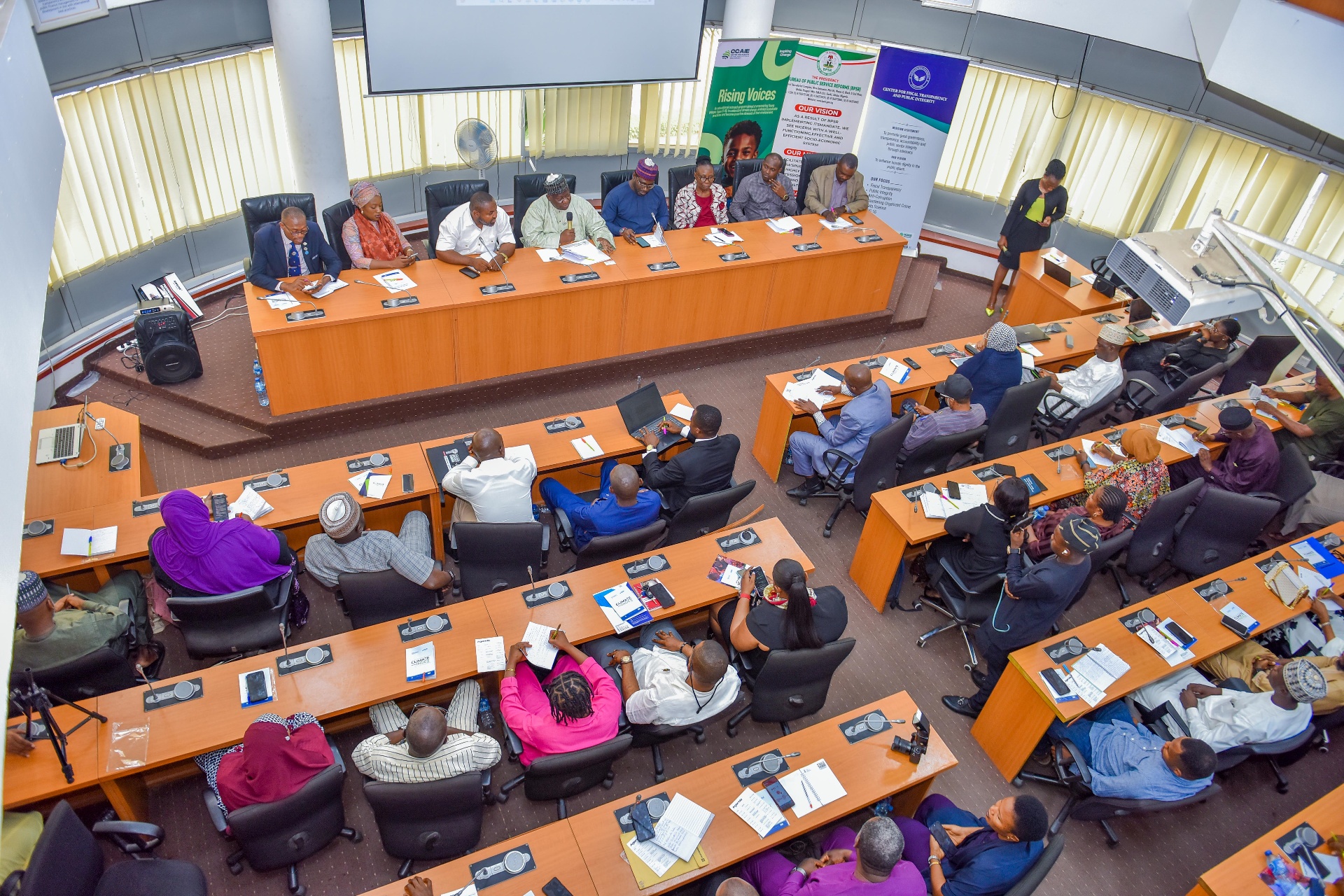
On June 5, 2026, CCAIE hosted a public input session to review, strengthen, and stress-test Nigeria's subnational climate-readiness baseline with stakeholders contributing evidence, local knowledge, and informed critique. A recap and validated methodology brief will be published on the CAI newsroom.
- Reviewed the baseline framework and FY2024–FY2025 findings.
- Gathered evidence, corrections, and lived experience.
- Shaping what the next version of the Index measures.
From the evidence base
Recent commentary, methodology notes, and engagement updates from the Climate Action Index team.
Nigeria's Subnational Climate Readiness Average Rises to 23.9%
The FY2025 baseline shows measurable improvement in publicly visible readiness, and a clear signal that progress remains low and uneven.
Read on CAI
How Public Documents Become Comparable Climate Readiness Scores
An evidence-to-score walkthrough of CAI's three pillars, scoring rules, and the deliberate logic behind the 40/30/30 weighting.
Read on CAI
Stakeholder Validation Strengthens CAI's Usability for State Teams
How structured engagement with researchers, civil society, and public-sector experts shaped a more usable and trusted index.
Read on CAIUsing CAI for climate advocacy and climate justice
CAI gives advocates, researchers, journalists, and civic actors a clear evidence base for asking sharper questions: which states have climate plans, which budgets show real commitment, where is public evidence missing, and where does readiness remain too weak for the risks communities face?
Expose readiness gaps
Identify where states lack public evidence of climate plans, budget alignment, implementation structures, or outcome reporting, and use those gaps to demand clearer action.
Ask better public questions
Brief journalists, civil society groups, legislators, and community advocates with evidence-backed questions about state climate performance.
Track progress and backsliding
Compare FY2024 and FY2025 readiness signals to see which states improved, declined, or remained stagnant, and where public pressure may be needed.
Download advocacy materials
Use baseline reports, ranking tables, state snapshots, and shareable infographics built for campaigns, briefings, media, and accountability work.
Built with partners across research, civil society, and public institutions.
The Climate Action Index is developed and delivered in collaboration with a network of implementing partners. Named partners include:
Centre for Fiscal Transparency and Public Integrity (CeFTPI)
Implementing partner, joint MoUs, stakeholder workshops, and public launches.
Bureau of Public Service Reforms (BPSR)
Public institution partner, engagement with subnational reform stakeholders.
State-level civil society and research collaborators
Evidence review, validation workshops, and dissemination.
Interested in partnering on the Climate Action Index? Reach out through our partner intake.
Go deeper on the CAI platform.
The full Climate Action Index lives on its own platform, explore the dashboard, baseline report, methodology, and advocacy downloads in detail.